

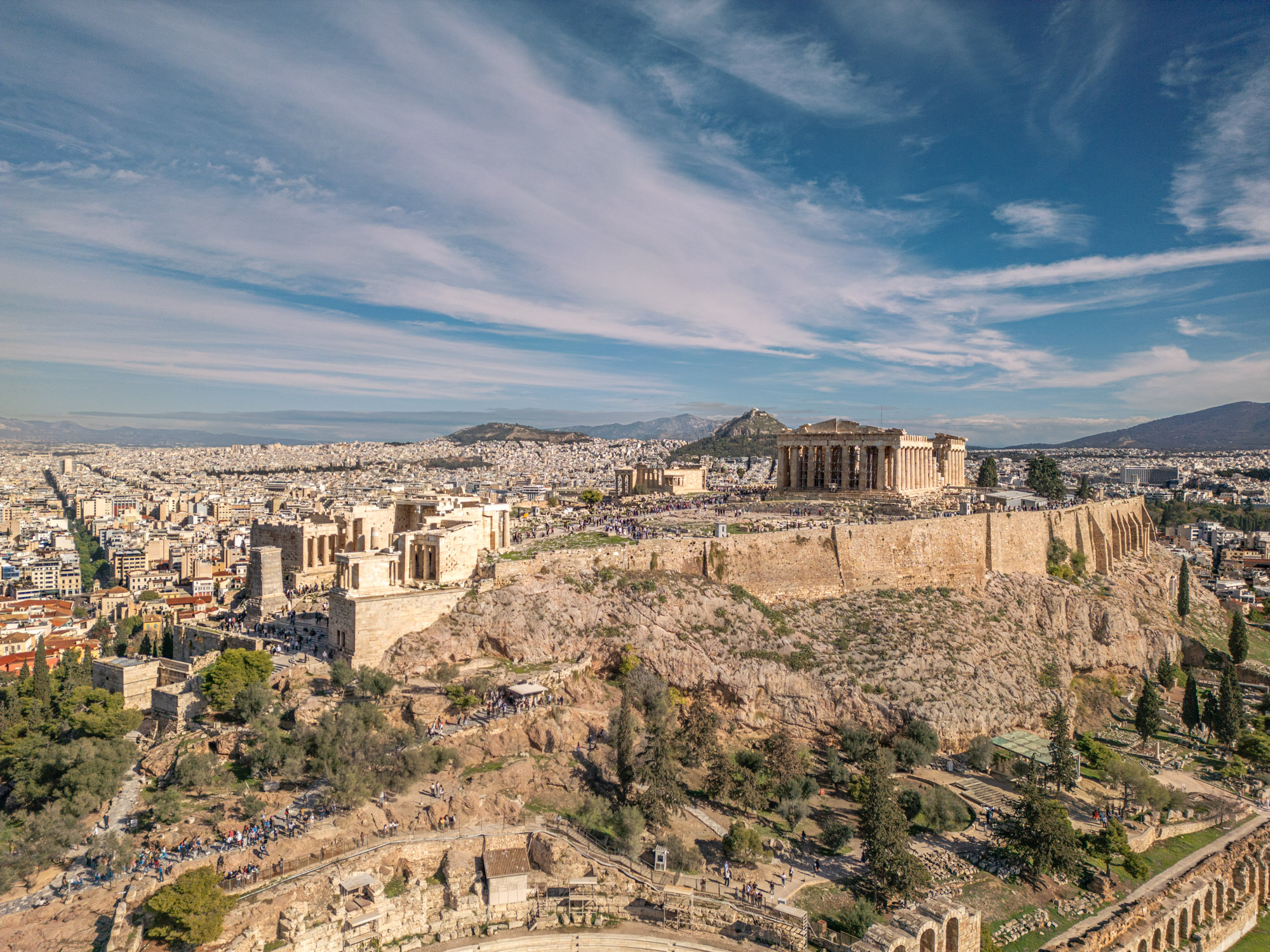
There are places in the world that feel ancient.
And then there is the Acropolis — a place that teaches you what “ancient” truly means.
Perched on its sacred limestone hill, visible from almost every corner of Athens, the Acropolis is not just a monument but the symbolic heart of Western civilization. No matter how many times you see it — from Plaka’s alleys, from Syntagma, from a moving train, or from a rooftop at night — it always feels like a first meeting.
Long before the temples, long before democracy, the Acropolis was a Mycenaean citadel, a fortified hill where early kings ruled (around 1200 BC).
For more than 3,000 years, this rock has held layers of myths, wars, rituals, triumphs, and rebirths.
But its golden age came in the 5th century BC, under the leadership of Pericles, when Athens reached its artistic and political peak. He commissioned a visionary building program that produced:
All crafted under the artistic direction of Phidias, the greatest sculptor of antiquity.
This was not architecture — it was a declaration of identity.
A message from Athens to the world: this is who we are, this is what we believe in — harmony, reason, and beauty.
Even ruined, even incomplete, the Parthenon remains the closest humans have come to architectural perfection.
Its brilliance lies in its illusions:
Built between 447–432 BC, the Parthenon once housed a colossal statue of Athena made of gold and ivory. It survived empires, transformations into a church and a mosque, and finally an explosion in 1687 — yet its presence remains overwhelming.
If the Parthenon is clarity, the Erechtheion is poetry.
Dedicated to the ancient myths of Athens — the contest between Athena and Poseidon, the sacred olive tree, and the tomb of the legendary king Kekrops — it is a sanctuary built on uneven ground, shaped by stories rather than symmetry.
The Caryatids, the six sculpted women acting as living columns, stand with grace that defies centuries.
The Acropolis changes with the light:
In black and white, the Acropolis becomes even more dramatic — the shapes, the shadows, the geometry reveal a side that colour can sometimes hide.
It becomes pure structure, pure history, pure presence.
Because it reminds us that humans once built with intention —
not just for utility, but for meaning.
Standing on the Acropolis, you feel time expand.
You understand how a small city on a rocky hill changed the world.
And for a moment, everything becomes clear and quiet —
as if the city is still speaking, and you finally have the time to listen.
Subscribe to get special offers, free giveaways, and once-in-a-lifetime deals.
© 2025 Ektos World – Nick Dessypris.