
The Silent Heartbeat of the Greek Nation
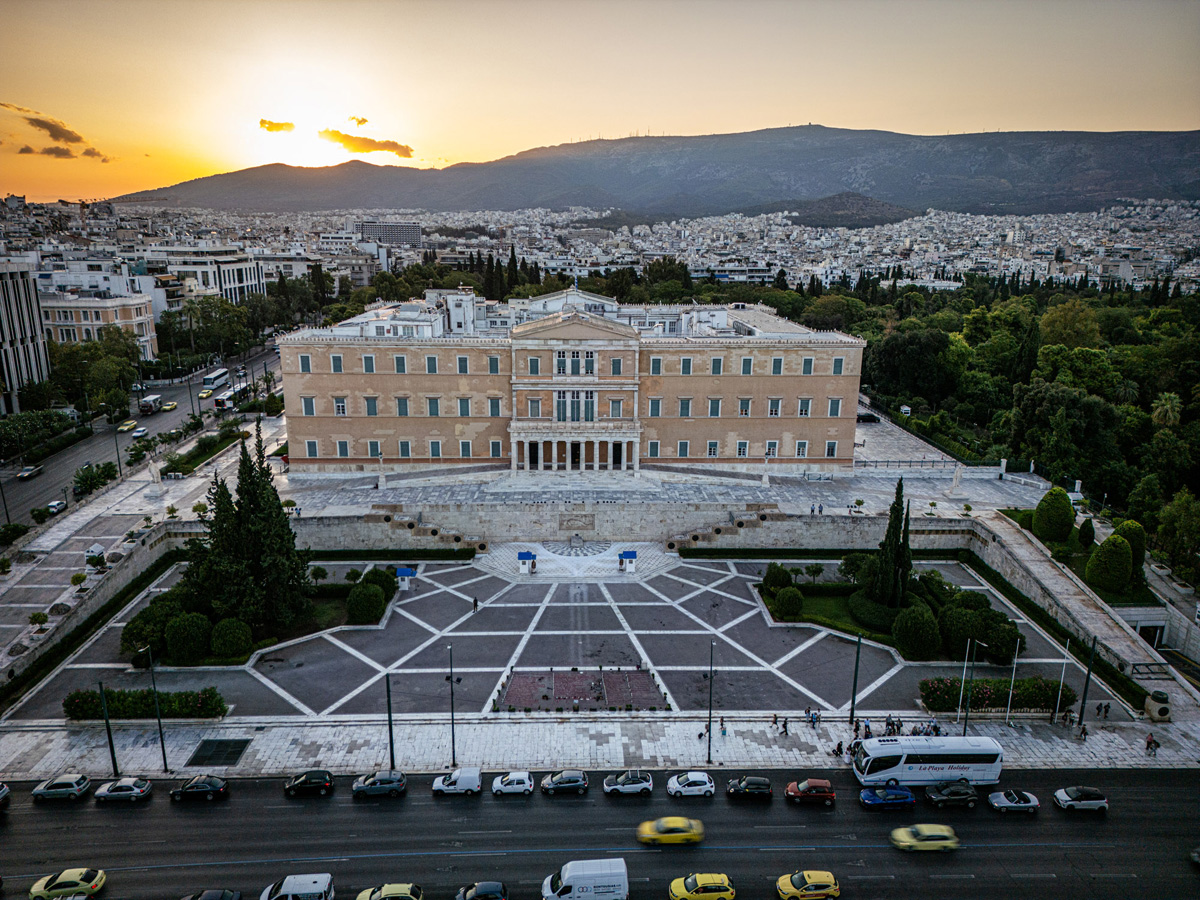
In the very centre of Athens, where avenues cross and the city breathes its busiest air, stands a building that carries the weight of modern Greek history.
The Hellenic Parliament — once a royal palace — rises above Syntagma Square with an austere calm, its long neoclassical façade watching over every gathering, ceremony, and quiet passerby.
At its feet lies one of the most meaningful monuments in Greece:
a single figure carved in stone, representing every soldier whose name was lost but whose sacrifice shaped the country.
A Palace That Became a Democracy
Completed in 1843 for King Otto, the building was originally a symbol of monarchy.
Earthquakes, fires, political turns, and the passage of time reshaped its purpose until, in 1934, it transformed into something far greater —
the permanent home of the Greek Parliament.
Its halls have witnessed debates, transformations, crises, celebrations, and the continuous effort of a nation to define itself through democracy.
The Eternal Presence of the Evzones
And then there is the spectacle every visitor remembers:
the Evzones, the elite presidential guard, standing immobile in their traditional uniform — the foustanella skirt, the pom-pom tsarouchia, the embroidered waistcoat.
Every hour they perform a ritual that is part choreography, part symbolism, part silent respect.
This ceremony is not for show.
It is a reminder that honour, in Greece, is carried with discipline, stillness, and dignity.
On Sundays, the grand changing of the guard becomes a living procession, accompanied by the military band.
It is one of the few traditions that unites locals and visitors in the same quiet admiration.
The Monument of the Unknown Soldier
Beneath the Parliament, carved into a long marble wall, lies a fallen hoplite —
a symbolic ancient warrior representing all Greeks who died without recognition in modern wars.
There is no name, no victory, no story.
Only the suggestion of a body resting forever in front of the Parliament,
reminding every government that their decisions rest on the sacrifices of ordinary men and women.
Two Evzones stand guard here at all times —
day and night, in heat, storms, silence, and celebration.
Their presence gives the monument a gravity that cannot be described, only felt.
Where Greece Gathers
Syntagma Square — the space in front of the Parliament — is the living courtyard of Athens.
Protests, celebrations, New Year’s Eve, Christmas lights, political speeches, march-pasts, and quiet evening walks all happen under the watch of this building.
It is a place where Greece expresses itself:
loudly, emotionally, freely, and without filters.
The Balance of Power and Memory
Together, the Parliament and the Monument of the Unknown Soldier form a pair:
one represents the living voice of the nation,
the other its silent memory.
One debates the future,
the other reminds us of the cost of the past.
Their contrast is not accidental — it is the centre of Greek civic identity.
A Moment Worth Stopping For
Stand by the monument at dusk.
Watch the guards shift, the city slow down, the lights of Syntagma reflect on the marble.
For a moment, the noise of Athens disappears, and you feel something ancient moving beneath the modern rhythm of the city.
This is not just a landmark.
It is a heartbeat of Greece — steady, symbolic, and unforgettable.
Subscribe to get special offers, free giveaways, and once-in-a-lifetime deals.
© 2025 Ektos World – Nick Dessypris.